Meaning of Japa?
In the vast tradition of yoga and spirituality, Japa is one of the simplest yet most powerful practices for calming the mind and deepening inner awareness. The term "Japa Japa" is often used to emphasize continuous mantra repetition, although the actual Sanskrit word is simply Japa.
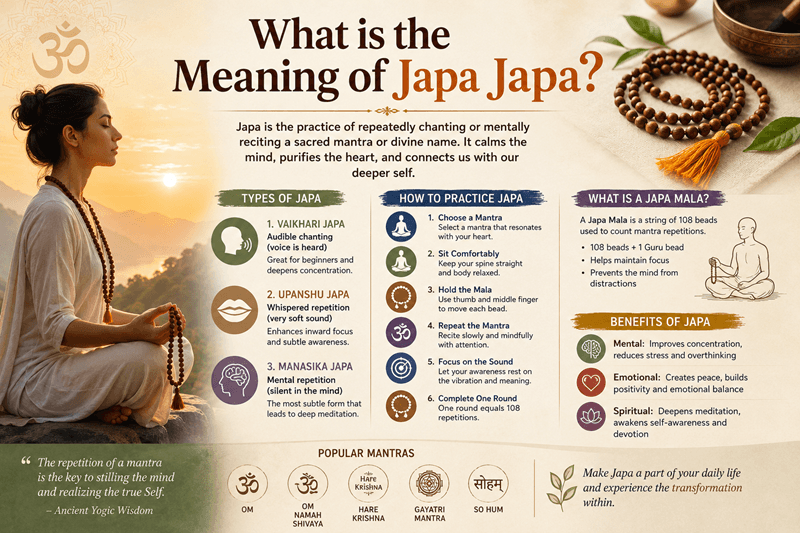
Japa is the practice of repeatedly chanting or mentally reciting a sacred mantra, divine name, or spiritual sound. For thousands of years, yogis, sages, and spiritual seekers have used Japa as a tool for meditation, concentration, and self-realization.
Whether practiced aloud, whispered, or silently within the mind, Japa helps direct awareness inward and creates a profound connection between the practitioner and the deeper dimensions of consciousness.
What Does Japa Mean?
The Sanskrit word Japa (जप) means "to mutter," "to repeat," or "to recite repeatedly."
Traditionally, Japa involves the repetition of:
- Sacred mantras
- Divine names
- Seed sounds (Bija Mantras)
- Spiritual affirmations
The purpose is not merely repetition but the cultivation of focus, devotion, and inner stillness.
Some of the most commonly practiced mantras include:
- Om (AUM)
- Om Namah Shivaya
- Hare Krishna
- Gayatri Mantra
- So Hum
The Origins of Japa
Japa has its roots in the ancient Vedic tradition of India. References to mantra repetition can be found in the Vedas, Upanishads, and various yogic texts.
Ancient sages discovered that sound vibrations influence the mind and energy system. Through consistent mantra repetition, practitioners could transcend mental distractions and enter deeper states of meditation.
Today, Japa remains a central practice in many spiritual traditions, including:
- Yoga
- Vedanta
- Bhakti Yoga
- Tantra
- Hinduism
- Buddhism
Different Types of Japa
1. Vaikhari Japa (Audible Chanting)
The mantra is spoken aloud so that the practitioner can hear it clearly.
Benefits:
- Easy for beginners
- Improves concentration
- Creates powerful vibrational effects
2. Upanshu Japa (Whispered Repetition)
The mantra is whispered softly with minimal sound.
Benefits:
- Enhances inward awareness
- Reduces external distraction
- Deepens concentration
3. Manasika Japa (Mental Repetition)
The mantra is repeated silently in the mind.
Benefits:
- Most subtle form of Japa
- Develops strong mental focus
- Leads to deeper meditation
Why is Japa Important in Yoga?
The human mind constantly moves from one thought to another. Japa provides a focal point that helps stabilize mental activity.
Regular practice can:
- Improve concentration
- Reduce stress and anxiety
- Cultivate inner peace
- Enhance meditation
- Develop spiritual awareness
- Strengthen devotion and faith
In yogic philosophy, the repetition of sacred sounds purifies the mind and helps remove mental fluctuations, known as Chitta Vrittis.
What is a Japa Mala?
A Japa Mala is a string of beads traditionally used to count mantra repetitions.
Most malas contain:
- 108 beads
- 1 Guru bead (the larger bead)
As each mantra is repeated, one bead is moved between the fingers. This helps maintain focus and prevents the mind from counting repetitions.
Popular materials include:
- Rudraksha
- Tulsi
- Sandalwood
- Crystal (Sphatik)
How to Practice Japa Meditation
Step 1: Choose a Mantra
Select a mantra that resonates with your intention or spiritual path.
Step 2: Sit Comfortably
Maintain an upright posture with a relaxed body.
Step 3: Hold the Mala
Use your thumb and middle finger to move each bead.
Step 4: Repeat the Mantra
Recite the mantra slowly and mindfully.
Step 5: Focus on the Sound
Allow your attention to rest fully on the vibration and meaning of the mantra.
Step 6: Complete One Round
One round equals 108 repetitions.
Benefits of Daily Japa Practice
Mental Benefits
- Reduces overthinking
- Improves concentration
- Enhances emotional stability
- Calms the nervous system
Emotional Benefits
- Creates feelings of peace
- Helps manage stress
- Encourages positivity
- Builds resilience
Spiritual Benefits
- Deepens meditation
- Awakens self-awareness
- Cultivates devotion
- Supports spiritual growth
Japa and Meditation
Many people wonder whether Japa and meditation are the same.
While they are closely related, Japa is generally considered a preparation for meditation.
Japa:
- Uses mantra repetition
- Gives the mind a specific focus
Meditation:
- Moves beyond repetition
- Cultivates pure awareness and stillness
Over time, consistent Japa naturally leads to deeper meditative states.
Common Mistakes in Japa Practice
Avoid these common errors:
- Repeating the mantra mechanically
- Practicing without attention
- Rushing through repetitions
- Constantly changing mantras
- Focusing only on numbers instead of awareness
Quality of repetition is more important than quantity.
Conclusion
Japa is one of the most accessible and transformative practices in the yogic tradition. Through the simple repetition of a sacred mantra, practitioners can cultivate concentration, inner peace, emotional balance, and spiritual growth.
Whether you are new to yoga or an experienced meditator, incorporating Japa into your daily routine can help quiet the mind and deepen your connection with your true self.
At Abhayaranya Yoga Ashram, we introduce students to traditional yogic practices such as mantra chanting, meditation, pranayama, and classical Hatha Yoga, helping them experience the authentic spiritual essence of yoga beyond physical postures.